
 Français
Incense, Spirituality, The Art of Incense
The Art of Incense – The Distinct Worlds of Heated and Stick Incense
Jan
The art of making incense is a blend of creativity and science that has evolved over thousands of years, from simple fumigation bundles, used to purify a space, to a sophisticated art whose makers seek to express the interconnectedness of fragrance, nature, the soul, and the divine best known in the compounded incense pellets known as Neri-koh (in Japan) or Kyphi (in ancient Egypt). As an incense maker and olfactory artist, working in the 21st century, I have an extremely wide range of incense forms, plant materials and extracts with which to create.

I have explored many forms of heated incense. Not only Neri-koh and Kyphi but also Greek Monastery resin pellets, Arabian Bakhoor, Biblical Ketoret and many varieties of granular incense. Each form requires a different approach and process which is a way I have used to expand my creative expression and skills. I like to push the limits of traditional techniques and experiment with combining forms and using non-traditional ingredients, that I gather in the forest, while seeking plants for physical, emotional and spiritual medicines.

The world of compounded heated incenses is where I am most at home. Their aromas are the purest expression of the voices of plants. They are the scentsuous landscape songs that I have heard since childhood, having lived in forests from the flowerful tropics to the coniferous boreal. I formulate whole blends in my head by memory, wandering in the forest, or smelling flowers in the garden. Using only natural ingredients to recreate the landscapes of these complex, olfactory experiences is at the heart of my work with heated incenses

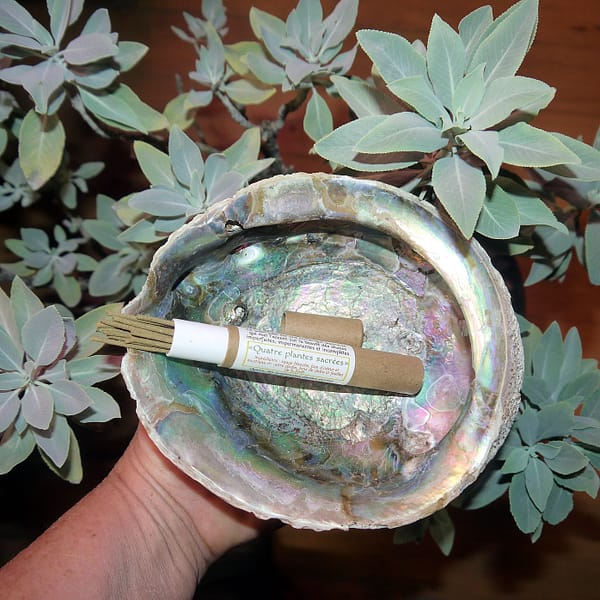
Two years ago, when I first started experimenting with Japanese-style incense sticks, my goal was, and still remains, to make combustible incenses that is the aromatic clarity of heated incenses. It is becoming clear, that this ambition will be a life long study, complete with the joys and tears of artistic creation along the way. Heated incense and Japanese combustible incense are very different olfactory arts. Making Heated incense is akin to painting with scent, using the luminescent layers and colors, of a Georgia O’Keeffe oil painting. I layer and juxtapose scents creating a vision which is very sensuous, but not overwhelming. Creating Japanese incense sticks is akin to carefully incising the fine lines of a Leonor Fini engraving. It demands a mindful, steady and sure hand to carefully arrange elements to achieve a harmonious result. Heated incense transports you to the heart of lush nature. Japanese incense sticks are a veiled memory of nature that finds substance in the fine-lines of its graceful smoke.

I have always thought about creating etchings as “making art around the corner”. Japanese incense sticks have this same “art around the corner” feeling as making engravings. Both require a lot of preparation before you experience the results. Making engravings entails drawing an image in reverse on a metal plate, then inking the lines and rolling the plate through a press with a damp piece of paper. Only when I lift the paper off the plate to see the results do I see if I must adjust the engraving plate or the inks. In combustible incense, multiple variations must be compounded, extruded and dried for a few days. Only when I light the stick do I begin to understand what the stick will smell like and how it needs to be adjusted.

The most challenging aspect of formulating for Japanese sticks was that I had to relearn my entire botanical, olfactory pallete. There are so many plants and resins that do not smell the same when burnt as when heated. Many of my beloved conifers’ needles loss all their lush, green scent when burned and smell like a spent campfire. Mushrooms loss their umami aroma but lichens’ scent still transports me to the forest floor. In incense sticks, fragrant resins, that have a gum portion, can develop terrible burnt tire notes. In combustible incense there are also limiting factors to the amount of any particular ingredient you can use. Most woods will speed up the burning while resins will slow the burn down to the point that the stick goes out. When formulating for stick incense I must keep a careful balance between scent and combustibility.

Then there is the “scent-shadow”. The scent-shadow is the fragrance that is left lingering in the room after an incense is finished diffusing. An incense’s scent-shadow is important because, after the incense is extinguished, this aroma can linger a considerable length of time in your environment. A heated incense’s scent-shadow is based on the perfumer’s concept of top, middle and long-lasting base notes. A heated incense’s notes unfold and mingle creating an ever-changing olfactory journey. A stick’s incenses fragrance is often linear when burning. Also, Its scent-shadow can be very different than its aroma while burning. A stick incenses’ scent-shadow can contain subtleties, nuances and even whole aroma notes that are not apparent in the immediate intensity of the smoke. Formulating for an incense stick’s scent-shadows adds another dimension to creating an olfactive experience. It is my favorite part, because the scent-shadow leaves a delicate trace in the air, hinting at something greater than the physical act of its burning. It reminds me that all art resides not in its form but in the intangible resonance it leaves within the soul.


