 Skip to content

 Français


MÉMOIRES LAURENTIDES
$22.00
Mémoires Laurentides is an incense that is a homage to the animated solitude of the Black Spruce/Cladonia forests of the Quebec Laurentides, a kingdom of spruces, mosses, and clear lakes. A landscape that stays inside many Quebecers for all of their lives.
“O landscapes From the early ages
My beautiful landscapes from back then!
O you, peaceful
Or sometimes terrible
In the heart of the northern mountains
O landscapes
The surroundings
With a beautiful boreal sky,
In the foliage and greenery
Among the great crystal lakes”
—Gaston Miron (Quebec poet)
The Laurentides carry many layered associations in the history of Quebec, for both its people and the non-human world. The Laurentide mountain range is an ancient geological world, shaped by the retreat of the Laurentide Ice Sheet — the name given to the enormous ice sheet that covered much of Canada and the northern United States during the last glaciation. The landscape, rivers, and lakes we see today are a consequence of the glacier’s retreat.
The Laurentides carry a high vibrational energy. They form a unique natural world Quebecers call Les Pays-d’en-Haut. It is a place where many Quebecers experience their first contact with wild nature and feelings they remember for the rest of their lives. And it’s no wonder: not only is the landscape magnificent, but in some places, large underground streams and heavy water coursing down steep, hidden subterranean rock fissures create deep, rumbling, barely audible vibrations. Energies that can be sensed in quiet spots, walking barefoot, or lying down on the ground.
Incense Notes: Cool, fresh, dark-balsamic conifer, mineral, earth
Heat this incense on an electric incense heater at 180º.
Ingredients: Black Spruce resin, Black Spruce needles; lichens — Monk’s Hood lichen, Old Man’s Beard (Usnea species), Horsehair (Bryoria species), Boreal Oakmoss Lichen, Powdered SunshineLlichen; in-house extracts of Black Spruce, Monk’s Hood lichen, and Black Pepper; Bursera microphylla resin; bound together with balsam fir resin and organic honey.
Inspiration
Inspiration for a bioregional incense blend sometimes comes at the strangest moments. I was driving the long highway that runs through the “Réserve Faunique des Laurentides” and needed to take a piss. I was at the very top of the mountain. I followed a sign for a pull-out, only to discover there were no bathrooms. The ground between the blacktop and the edge of the forest was littered with toilet paper left by drivers who had gone before me. As a wildcrafter, I’m no stranger to offering fertilizer to the understory, so I stepped over the embankment and went deeper into the forest.

Twenty feet in, my feet sank into humus more than a foot thick. Hummocks of green moss and pale white reindeer lichen carpeted the forest floor. All around me stood Black Spruces heavily laden with lichens, many of which I had never seen before — yellow lichens that glowed like jewels, foliose lichens the size of cabbage heads, and so many species of Usnea and Bryoria hanging from the branches like long, tangled threads. I had stumbled into a particular boreal environment called a Black Spruce/Cladonia forest.
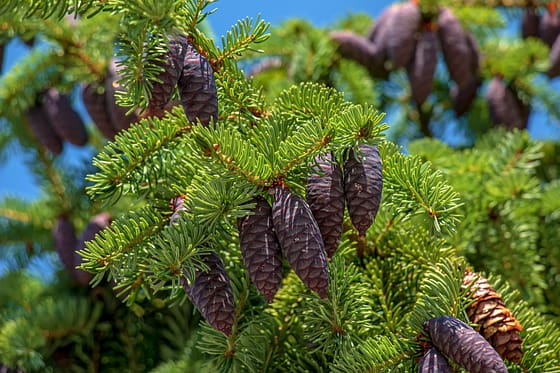
The Black Spruce/Cladonia forest is another unique expression within the dominant balsam fir–yellow birch boreal forest scattered through the Laurentides. That Black Spruce is there at all is an unusual evolution, because Black Spruce is mainly a fire-dependent germinator. Its cones open to release their seeds after intense heat. Yet the Laurentides is not a fire-dependent ecosystem; if anything, it is a consistently moist one. As a back-up to fire, the trees release a few wind-borne seeds every year, and that is how the first seeds found their way into the Laurentides. There, the Black Spruces established refugia alongside lichens, in acidic, waterlogged, nutrient-poor sphagnum bogs.
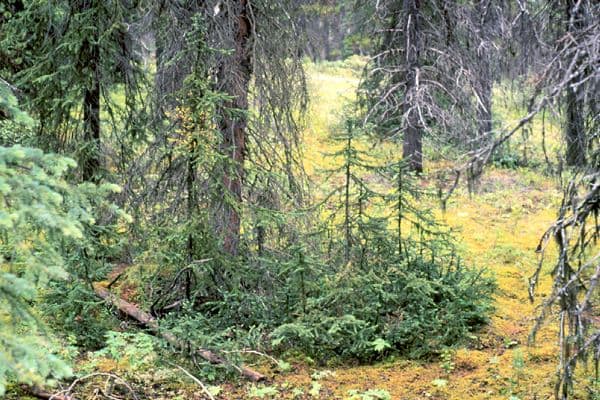
Instead of propagating by fire-stimulated seed, the trees reproduce mainly by layering. Low branches root where they touch the ground. It’s genuinely common in old Black Spruce bogs to find that a large ring or patch of stems all comes from a single individual tree, one that has been vegetatively cloning itself through layering for a very, very long time.
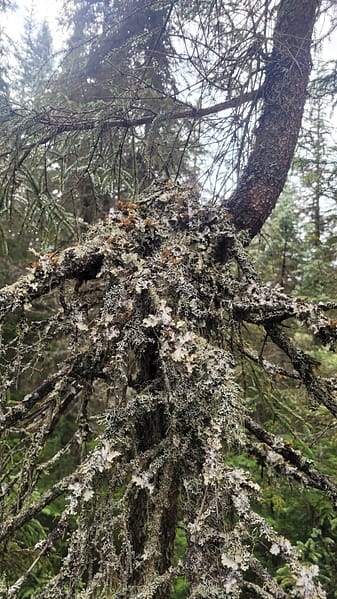
The Black Spruces create the exact shaded conditions in which slow-growing, acid-loving lichens thrive. Over the years, lichens of every kind hang and grow on the trees, while a carpet of soft lichen, more than a foot deep in places, develops on the forest floor. The coniferous, resinous, lichen-laced scent of the Black Spruce/Cladonia forest preserves something ancient with a primordial northern aroma.
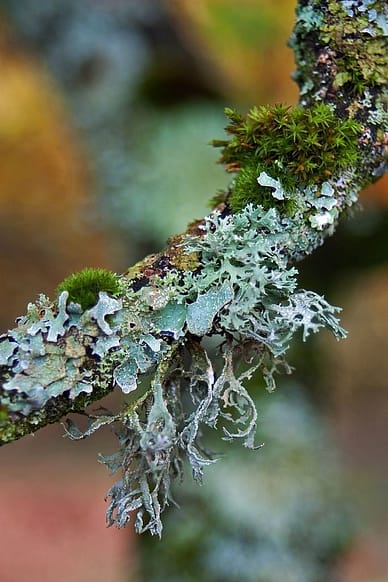
The visual of the spruces and the thousands of Lichens was dazzling, but the fragrance, and the body-high it gave me, was even more impressive. The sweet, mentholated, faintly fruity aroma of the Black Spruces mingled with the earthy, sour fragrance of the mosses and lichens. The air felt supercharged with oxygen and with the healing aerosols of the trees. I was immediately energized, almost giddy and lifted into an unusual, heightened state, something close to the sensation of certain psychedelics.
Spruces, like their conifer kin, are filled with complex biochemicals that drift into the air as fine aromatic aerosols. They release both antiseptics and antibiotics, purifying the air by working against the mycobacteria carried within it. Spruce species seem particularly committed to this cleansing work. They even release a compound that triggers the lichens growing on them to manufacture their own antibiotics in turn. These, too, are gathered up in the spruces’ carrying aerosols before drifting south.
Before the aerosol finally drifts away, the spruce contributes one last gift to its healing blend: a sticky compound that acts as a natural adhesive. Through it, the tree’s medicine finds its way to exposed wounds and irritated lungs, helping to ward off infection. All of these medicines travel south on winds filled with the fragrant, highly oxygenated breath of the spruces.

That day, in the heart of a small Black Spruce–Cladonia grove, I stood at the very source of the Boreal’s medicine, immersed in the breath of life. It was, quite literally, awesome. The art of incense is one of the few ways I know to pay homage to a moment like that. So, I had a little conversation with the spruces and the lichens, and was given permission to fill my pockets as part of their medicine path. This is the incense painting of their breath painting with the botanicals gifted to me that day
.


Reviews
There are no reviews yet.